
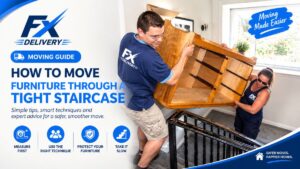
How to Move Furniture Through a Tight Staircase
Moving a sofa, wardrobe, bed frame or other large piece of furniture through a narrow staircase can quickly become the hardest part of a house move. A staircase may look wide enough at first glance, but the real challenge often appears at the landing, around a corner, beneath a low ceiling or where a banister reduces the usable space.
The safest approach is not to rely on strength alone. Measure the furniture and the complete route, work out how the item needs to be positioned, protect the property and decide beforehand whether the job is suitable for a DIY move.
This is particularly important in Sheffield, where many older homes have compact hallways, narrow staircases and awkward turns. The following guide explains how to approach the problem without turning moving day into a battle with your furniture.
Start by Measuring the Furniture and Staircase
Before lifting anything, measure the piece of furniture carefully. Record its height, width, depth and, for long items such as sofas, its overall length.
Then measure the route it needs to travel.
Do not measure only the staircase itself. Check:
- The narrowest point of the staircase.
- Doorway widths at the top and bottom.
- Landing dimensions.
- Ceiling height above the stairs.
- Space around corners and banisters.
- Hallway width leading to the staircase.
- Any radiators, light fittings or other fixed obstacles.
The narrowest point usually determines whether the move is possible.
For example, a sofa might be narrower than the staircase but still fail at a 90-degree landing because there is not enough room to rotate it. This is why simply comparing the sofa’s width with the stair width can give you a false sense of confidence.
Understand How the Furniture Needs to Turn
Large furniture rarely travels upstairs in the same position in which it normally sits.
A sofa may need to be placed on its side, tilted vertically or rotated gradually around a landing. A tall wardrobe may need to be tipped backwards while its base is guided around a corner.
Before attempting the move, consider the item’s centre of gravity and where each person will stand. The goal is to control the furniture rather than allowing its weight to dictate its movement.
Check the route before lifting
Walk the complete route without the furniture first. Imagine where the front and rear ends of the item will be at each stage.
If there is a tight turn, identify the exact point where the furniture will need to rotate. This can reveal problems that are difficult to see once several people are holding a heavy object.
For particularly awkward pieces, taking measurements and making a simple sketch of the route can be surprisingly useful.
Remove Anything That Makes the Staircase Narrower
Small changes can create valuable clearance.
If it is safe and practical to do so, remove doors that restrict the entrance to the staircase or furniture route. Temporary removal of a banister may sometimes be possible, but this should only be done by someone who understands how it is safely secured and reinstated.
Also remove:
- Pictures and mirrors near the route.
- Decorative items.
- Rugs that could move underfoot.
- Freestanding lamps.
- Small tables or hallway furniture.
- Shoes, boxes and other loose objects.
Do not remove structural elements simply to make a piece fit. If the route appears impossible without altering the building, stop and reassess the move.
Dismantle the Furniture Where Possible
One of the easiest ways to make a difficult staircase manageable is to reduce the size of the furniture.
Check whether the item can be dismantled without damaging it. Bed frames, dining tables, shelving units and some wardrobes can often be separated into smaller sections.
Sofas require more caution. Some models have removable legs, backs or other components, while others are constructed as one piece. Check the manufacturer’s guidance or have the item assessed before attempting to take it apart.
Keep every screw, bracket and fitting in a labelled bag. A useful approach is to label the bag with the furniture name, such as “main bedroom wardrobe fittings”, and keep it with the relevant parts.
Do not dismantle furniture simply because it is heavy. The objective is to make it smaller or easier to manoeuvre, not to create unnecessary work.
Protect Walls, Floors and the Furniture
Tight staircases leave very little room for error. A small movement can cause a sofa to scrape a painted wall or a wardrobe corner to hit the ceiling.
Protect the route before the first large item is moved.
Use suitable furniture blankets or padding on vulnerable furniture surfaces. Protect floors where necessary and make sure any coverings are secured so they cannot become a trip hazard.
Pay particular attention to:
- Stair edges.
- Wall corners.
- Door frames.
- Banisters.
- Painted surfaces.
- Hardwood or delicate flooring.
Protective materials should never compromise the carriers’ footing. A secure grip and stable walking surface are more important than covering every inch of the property.
Use the Right Equipment
Heavy furniture becomes significantly harder to control on stairs. Appropriate moving equipment can reduce strain, but equipment must be used correctly.
Furniture blankets, lifting straps, protective padding and suitable hand trucks may be useful depending on the item and route.
However, a standard four-wheel furniture dolly is not automatically suitable for stairs. Wheeled equipment designed for flat surfaces can become difficult to control on steps.
For a staircase with a sharp turn, very narrow treads or a heavy item, specialist equipment and trained movers may be more appropriate than improvised solutions.
Never use makeshift ropes, unstable platforms or household items as substitutes for proper moving equipment.
Use Enough People and Communicate Clearly
A common mistake is trying to move a large piece with too few people.
The number required depends on the weight, dimensions and route. More people are not automatically better either. Too many people in a narrow staircase can make communication and movement more difficult.
Everyone should know their position before lifting.
Use simple instructions such as “stop”, “up”, “down”, “turn” and “hold”. One person should coordinate the movement so several people are not giving conflicting directions.
Never rush because someone is waiting downstairs. If the furniture becomes unstable, stop and reposition it.
Moving a Sofa Through a Tight Staircase
Sofas are among the most awkward household items because their length makes corners difficult.
First remove cushions and detachable legs. Measure the sofa’s height and depth, then compare these with the staircase and landing.
A sofa may need to be tilted almost vertically to negotiate a tight corner. Before doing this, make sure there is sufficient clearance above the staircase and that the people carrying it have secure hand positions.
If the sofa catches against a wall or ceiling, do not force it through. Pulling harder can damage both the furniture and the property.
Sometimes changing the angle by a few degrees makes the difference. If it still cannot pass safely, dismantling or an alternative route may be necessary.
What If the Furniture Simply Will Not Fit?
There are occasions when careful manoeuvring is not enough.
If the measurements show that the furniture physically cannot negotiate the staircase, consider another route through the property. Depending on the building, a larger doorway, ground-floor route or suitable external access may provide an alternative.
Removing furniture through a window or balcony is a specialist operation and should not be improvised. Large objects can be extremely dangerous if dropped or poorly supported.
For valuable, exceptionally heavy or unusually shaped furniture, professional assistance is usually the safer option.
When Should You Hire Professional Movers?
A tight staircase is a good reason to discuss the property with a removal company before moving day rather than discovering the problem when the vehicle arrives.
Professional movers can assess factors that are easy for homeowners to overlook, including stair geometry, access, furniture weight, landing space and the number of people needed.
Professional help is particularly sensible when:
- The staircase is very narrow or steep.
- There is a sharp or restricted landing.
- Furniture is exceptionally heavy.
- The item is expensive or difficult to replace.
- You are moving a piano, safe or similarly specialised item.
- There is a significant risk of injury or property damage.
- The furniture cannot be dismantled easily.
If you are arranging a move in Sheffield or elsewhere in the UK, FX Delivery can be considered as part of your planning. The company’s services can be reviewed at fxdelivery.co.uk when you need to discuss removal and delivery requirements.
The most useful information to provide when requesting a quote is not simply the number of rooms. Explain the access conditions, number of floors, staircase shape, parking situation and any large items that need special handling.
A Simple Pre-Move Staircase Checklist
Before moving a large item upstairs, check the following:
| Check | What to confirm |
|---|---|
| Furniture size | Height, width, depth and overall length |
| Staircase | Narrowest width and step configuration |
| Landing | Enough space to rotate the item |
| Ceiling | Clearance when furniture is tilted |
| Doorways | Width and available opening |
| Obstacles | Banisters, radiators, lights and furniture |
| Furniture | Removable legs or sections |
| Protection | Walls, floors and furniture properly protected |
| People | Enough trained help for the weight and route |
| Equipment | Appropriate moving equipment available |
| Alternative | Another route available if the item will not fit |
Do Not Force a Furniture Move
The biggest mistake when moving furniture through a tight staircase is treating the problem as a test of physical strength.
If an item becomes stuck, stop. Forcing it can damage a wall, break furniture components or cause someone to lose their footing. Recheck the angle, remove any unnecessary obstacles and consider whether the furniture can be dismantled.
If the measurements suggest that the route is too restrictive, professional assessment is a better solution than taking risks.
Conclusion
Moving furniture through a tight staircase requires planning more than brute force. Measure the furniture and the entire route, pay attention to corners and landings, dismantle suitable pieces, protect the property and make sure everyone understands how the move will be carried out.
For Sheffield homes with narrow stairs or awkward access, dealing with these challenges before removal day can prevent significant delays. And when a heavy or valuable item presents a genuine safety problem, professional movers with the appropriate experience and equipment can make the job considerably safer.
A few minutes spent measuring and planning can save hours of frustration—and potentially prevent damage to both your furniture and your home.